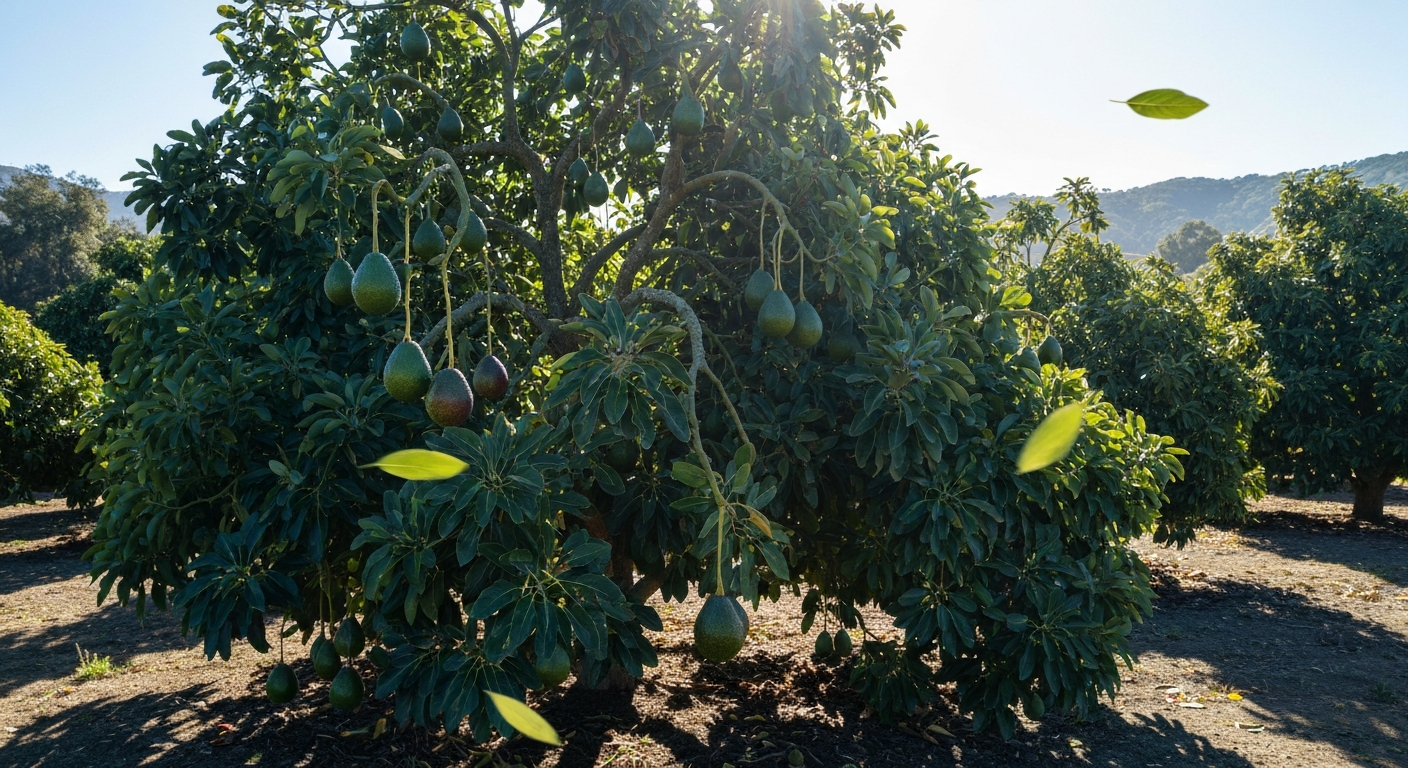
Avocado Trees
Care Guide
Avocados have among the most sensitive root systems of any commonly grown fruit tree. Understanding their biology is the difference between a thriving producer and a declining liability.
Understanding Avocado Trees
The Avocado (Persea americana) is native to Mexico and Central America and has been cultivated in Southern California for over a century. Ventura County remains one of the largest avocado-producing counties in the United States, and avocado trees are ubiquitous on estates, ranch properties, and large residential lots throughout our service area.
The Hass avocado dominates commercial production, though estate properties often feature a variety of cultivars including Fuerte, Bacon, Reed, Lamb Hass, and Pinkerton, selected for taste, season, and size. Most named cultivars are grafted onto rootstocks specifically selected for disease resistance — the most critical of which is tolerance to Phytophthora cinnamomi, the primary cause of avocado root rot.
The fundamental challenge of avocado care is understanding its root system. Avocado feeder roots are exceptionally shallow — concentrated in the top 6 inches of soil — and exceptionally sensitive. They need consistent moisture but cannot tolerate waterlogged conditions for even short periods. They are highly sensitive to salinity, soil compaction, and foot traffic. Getting the water balance right is the defining skill of successful avocado management.
Equally important is understanding Phytophthora cinnamomi (avocado root rot), which has no cure and is endemic in most avocado-growing soils in Southern California. Management of this pathogen through irrigation precision, phosphonate applications, and mulching is a continuous commitment for any productive avocado orchard.
Quick Reference
Common Problems With Avocado Trees
Phytophthora Root Rot — The #1 Threat
Phytophthora cinnamomi is a water mold pathogen that destroys the feeder root system of avocado trees. It thrives in waterlogged, poorly-drained soils. Once established, it cannot be eliminated — only managed. Symptoms include declining yield, wilting despite adequate soil moisture, tip burn on leaves, small pale leaves, and gradual crown thinning leading to death. Management requires: proper drainage, precise irrigation, regular phosphonate (phosphorous acid) trunk injections or soil drenches, and maintenance of a deep organic mulch layer. See our Root Rot guide.
Polyphagous Shot Hole Borer (PSHB)
The PSHB is a significant and growing threat to avocado trees in Southern California. The beetle bores into the tree and introduces a fungal pathogen (Fusarium euwallacea) that causes branch dieback. Avocado is a highly susceptible reproductive host — meaning the beetle can complete its life cycle within avocado wood. Trees showing PSHB symptoms require immediate professional assessment. See our Shot Hole Borer guide.
Persea Mite
The Persea Mite (Oligonychus perseae) is a significant avocado pest in Southern California. It feeds on the underside of leaves, creating distinctive bronzed patches and webbing. Severe infestations cause premature leaf drop, reducing photosynthesis and fruit production. Miticide treatments during peak activity (spring and summer) and conservation of natural predators are the primary management strategies.
Salt Burn & Chlorosis
Avocados are extremely sensitive to soil salinity. Symptoms include brown leaf margins (salt burn), yellowing between veins (chlorosis from nutrient lockout), and reduced vigor. Southern California water sources vary significantly in salt content — using a certified soil and water testing laboratory to measure electrical conductivity and specific ion levels guides appropriate management. Leaching and soil amendment are the primary responses.
Frost Damage
Avocados are frost-sensitive, particularly when young. Hass and most commercial varieties are damaged below 28–30°F. Estate properties in interior valleys with occasional hard frosts should plan protection strategies for young trees (wrapping, overhead frost protection, site selection on slopes where cold air drains away). Frost-damaged growth should be left until spring to accurately assess the extent of damage before pruning.
Sunburn
Avocado bark is highly susceptible to sunburn when exposed by heavy pruning or branch removal. Sunburned bark develops cankers that invite secondary fungal pathogens. Protective white latex paint (50% water diluted) applied immediately after pruning significantly reduces sunburn risk on exposed branches and trunk sections. This is a routine precaution for all significant pruning work on avocados.
Pruning Avocado Trees
Best time to prune: Spring through early summer, after flowering and early fruit set. Avoid late summer and fall pruning — new growth stimulated by late-season pruning is vulnerable to frost.
Pruning objectives: Manage tree height and size for harvest efficiency. Maintain light penetration into the canopy interior. Remove dead, diseased, and PSHB-infested wood promptly. Provide clearance from structures and adjacent trees.
Critical caution: Avocado bark burns easily when exposed to direct sun after pruning. Paint all exposed wood immediately with diluted white latex paint. Never remove more crown than necessary in a single pruning — large cuts create stress and sunburn risk simultaneously.
Root zone protection: Never cultivate or disturb the soil in the root zone of avocados. Feeder roots are in the top 6 inches — routine rototilling or cultivation destroys them. Use mulch, not bare soil, throughout the root zone.
ANSI A300: Apply ANSI standards but recognize that avocado management also incorporates horticultural production principles. All structural work should be performed by someone with specific avocado experience.
Irrigation & Nutrition
Water is the #1 management variable: Avocados need consistent moisture in the top 12–18 inches of soil but cannot tolerate saturation for even 24–48 hours without feeder root damage. The goal is "moist but never wet."
Young trees: Water every 3–4 days during warm weather in the first year. Gradually extend the interval as the tree establishes. Use a soil probe or moisture meter to guide decisions — do not rely on visual inspection.
Established trees: Irrigate deeply every 7–10 days during summer, every 14–21 days during cool winter months. A drip or micro-spray system covering the entire root zone (2–3x the canopy diameter) is optimal.
Mulching: Maintain 4–6 inches of organic mulch throughout the root zone (keep 6 inches away from the trunk). Mulch reduces soil temperature fluctuation, conserves moisture, suppresses weeds, and most importantly, suppresses Phytophthora — the single most valuable cultural practice for avocado health.
Fertilization: Avocados are moderate to heavy feeders. Nitrogen applications 3–4 times per year (avoid fertilizing during bloom). Zinc deficiency is common in alkaline soils — chelated zinc applications address this. Soil and leaf tissue testing every 2–3 years guides a precision nutrition program.
Avocado Tree FAQs
Why is my avocado tree losing leaves even though I'm watering it?
This is a classic symptom of Phytophthora root rot. The root system is compromised and cannot deliver water even when soil moisture is adequate. Overwatering is the most common trigger — it creates the waterlogged conditions that allow Phytophthora to thrive. Reduce irrigation frequency, assess drainage, and contact a Certified Arborist immediately.
How do I know if my avocado has Phytophthora root rot?
Key symptoms: declining yield over several seasons, leaves that wilt and don't recover with irrigation, small pale leaves, tip burn, progressive crown thinning, and a pattern of decline that worsens in wet years. Confirmation requires root examination — a Certified Arborist can conduct a formal diagnosis. There is no lab test that can be done from a leaf sample.
Can Phytophthora root rot be cured?
No. Once Phytophthora is established in the soil, it cannot be eliminated. It can be managed through precise irrigation, excellent drainage, phosphonate (phosphorous acid) treatments, and deep organic mulch maintenance. Trees with good management can remain productive for decades despite having Phytophthora present in the soil.
What are phosphonate treatments and does my avocado need them?
Phosphonate (phosphorous acid) is a systemic compound that stimulates the avocado tree's own defense mechanisms against Phytophthora. Applied as a trunk spray, drench, or injection, it is one of the most effective tools for managing root rot in avocado orchards. Most avocados in Southern California that are showing any signs of decline benefit from regular phosphonate applications 2–3 times per year.
How much water does an avocado tree actually need?
Mature avocado trees in Southern California typically require 50–100 gallons of water per week during summer, depending on tree size, temperature, and soil type. A single mature avocado tree has one of the highest water requirements of any commonly grown landscape or orchard tree. Water management accounts for more avocado failures than any other factor.
My avocado has tiny holes in the bark with dark staining around them. What is it?
This is the signature sign of Polyphagous Shot Hole Borer (PSHB). The dark staining (called 'frass') is the fungal pathogen the beetle introduces. Contact a Certified Arborist immediately — avocado is a reproductive host, meaning beetle populations can build rapidly within the tree.
Why does my avocado tree produce flowers but no fruit?
Avocados have an unusual pollination biology — Type A and Type B flowers open at different times. Most orchards need trees of both types for reliable pollination. Other causes of poor fruit set: frost during bloom, excessive heat during bloom, heavy rainfall washing pollen, poor bee activity, or over-mature trees in decline.
How do I manage the leaf litter from my avocado trees?
Avocado leaves decompose slowly and can accumulate significantly. Do not allow thick, wet leaf piles against the trunk — this creates ideal conditions for Phytophthora. Mulch leaf litter in place between trees if it doesn't create excessive moisture, or compost it away from the root zone. Never burn avocado leaves near the tree.
When should an avocado tree be removed?
When it has been positively identified as having PSHB infestation beyond management, has structural failure risk from rot or physical damage, or has declined beyond the point of productive recovery despite sustained management efforts. A formal evaluation by a Certified Arborist with avocado experience is the appropriate process.
Related Resources
Concerned About Your Avocado Trees?
Avocado management requires specialized expertise. Our ISA Certified Arborists provide comprehensive diagnostics and care programs for estate avocado orchards throughout Southern California.
Schedule a Free Consultation